
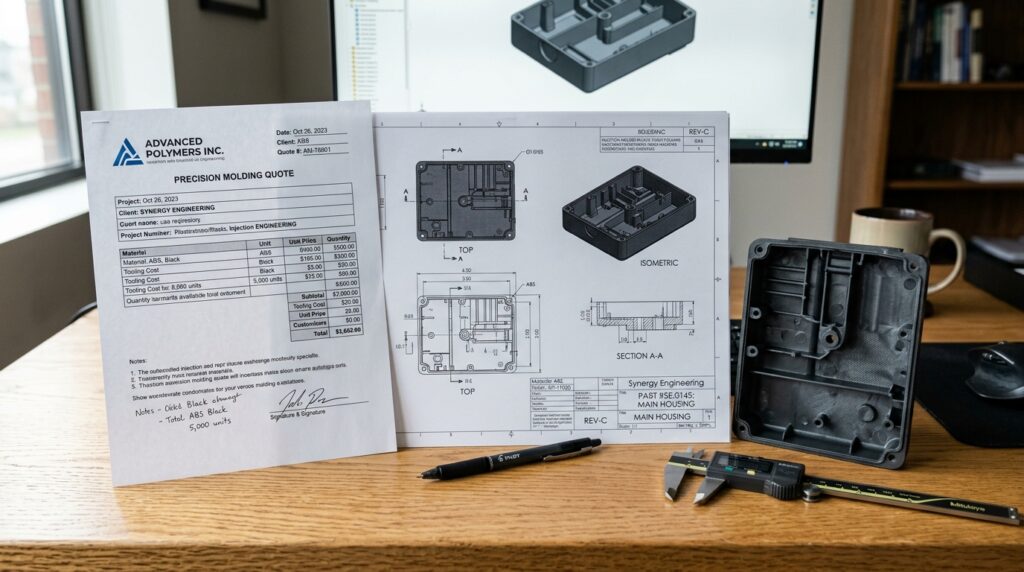
What Is Factored In When We Quote a Part to Be Moulded?
A moulding quote can look like a single number, but it’s really the output of a dozen smaller decisions stacked on top of each other: material, geometry, tooling, volume, tolerances, and a handful of things most people never think to ask about until the invoice arrives. This guide breaks down exactly what goes into that number, so the next quote you receive makes sense line by line instead of feeling like a black box.
Below are the 10 questions I get asked most often when a client is looking at a moulding quote and trying to understand what’s actually driving the price.
- What Actually Goes Into a Moulding Quote, Beyond a Single Price Per Part?
- How Does Part Geometry and Complexity Affect the Quote?
- Undercuts, requiring side-actions or lifters in the tool
- Multiple cavities to increase output per cycle, which multiplies tool cost but reduces per-unit cost at volume
- Fine surface detail or texture, which affects both tool machining time and finishing
- Wall thickness – thicker sections take longer to cool before the part can be ejected
- Part size – larger parts generally mean longer fill and cooling times
- How Does Material Choice Change the Quote?
- How Is Tooling Cost Calculated, and Why Does It Dominate?
- How Does Order Volume Change the Per-Unit Price?
- What Role Do Tolerances and Finish Requirements Play in the Quote?
- How Do Secondary Operations Affect Pricing?
- Assembly combining moulded parts with other components, fasteners, or inserts
- Pad printing or labelling adding branding, instructions, or part numbers
- Ultrasonic welding or bonding joining multiple moulded pieces together
- Custom packaging specific carton sizes, foam inserts, individual bagging, or component kitting
- What Hidden or Overlooked Costs Catch People Off Guard?
- Freight and packaging costs, if not explicitly included in the quoted price
- Tooling maintenance costs over the tool’s working life, particularly for high-volume production
- Costs for engineering changes after tooling is cut, which are often far higher than the same change made during design review
- Minimum order quantity penalties if your actual order falls below a supplier’s quoted volume tier
- Storage or holding fees if a supplier warehouses finished stock on your behalf
- What Mistakes Do People Make Comparing Quotes From Different Suppliers?
- How Do You Get an Accurate, Genuinely Comparable Quote?
- The same CAD file or drawing, with the same tolerances clearly marked
- The same material specification, including grade, not just a general material family
- The same expected annual volume and order batch size
- The same list of required secondary operations: assembly, printing, packaging
A moulding quote is really several separate cost lines rolled into one number: tooling (often quoted separately, sometimes amortised into the unit price), material cost per part, machine run time, labour, secondary operations, packaging, and freight. When two quotes come back at different prices, the difference is almost always in how these components are weighted, not in one supplier simply being “cheaper.”
In my experience, the quotes that are easiest to trust are the ones broken down into these separate line items rather than presented as a single all-in number. A one-line quote makes it hard to tell whether you’re comparing apples to apples against a competing quote.
My Take: A Detailed Quote Is a Sign of a Serious Manufacturer
My opinion, after reviewing plenty of these quotes on a client’s behalf, is that a manufacturer who happily itemises tooling, material, and run-time costs separately is signalling confidence in their own numbers. A single bottom-line figure with no breakdown, especially one that comes back suspiciously fast, is worth double-checking.
Geometry drives cost in two separate ways: how complex the tool needs to be to produce the shape, and how long each part takes to mould (cycle time).
What Adds Tooling Complexity
What Affects Cycle Time
A part that looks simple on screen can still carry hidden cycle-time cost if it has thick sections buried inside an otherwise simple shape; this is one of the more common surprises in a first quote.
Material cost is charged by weight, so part volume and wall thickness directly affect material spend but the material grade itself also swings the number significantly.
| Material | Relative Cost | Why |
|---|---|---|
| Polypropylene (PP) | Lower | Commodity resin, widely available, low cost per kilogram |
| ABS | Lower-Moderate | Common consumer-grade resin with good finish |
| Nylon (PA) | Moderate-Higher | Engineering-grade resin, more expensive to produce |
| Glass or carbon fibre reinforced grades | Highest | Reinforcement fibre adds material and processing cost |
My honest opinion: always ask a supplier to separate material cost from processing cost on the quote. Suppliers sometimes bundle a material upgrade into the overall number without flagging it clearly, and you want to know whether you’re paying for a more expensive resin or a more expensive process.
Tooling the mould itself is typically the largest single line item in any moulding project, often quoted separately from the per-unit part price. Tooling cost is driven by the complexity of the part (cavities, side-actions, textured surfaces), the size of the tool, and the steel grade chosen for the expected production life.
Soft (Bridge) Tooling vs. Production Tooling
Soft tooling, often aluminium, is cheaper and faster to make but wears out after a few thousand cycles a lower up-front quote but not suited to long production runs. Production tooling, usually hardened steel, costs more up front but runs far higher volumes before needing replacement.
Why This Line Item Matters for Comparing Quotes
Two suppliers quoting a similar per-unit part price can still differ enormously on tooling cost. Always compare tooling and per-unit price as two separate numbers, not folded into one. A lower per-unit price with a much higher tooling quote might not actually be the cheaper option at your expected volume.
Tooling is a fixed, one-off cost. Spread across a small production run, it adds significantly to each part’s effective cost; spread across a large run, its impact per part shrinks close to zero. This is why the same tool can produce parts that feel expensive at low volume and remarkably cheap at high volume.
Tighter tolerances and higher cosmetic finish requirements both add cost, for different reasons.
Tolerances
Standard commercial tolerances are achievable with routine tooling and process control. Tighter tolerances needed for precision-fit assemblies, for example, often require more careful mould-making, slower cycle times, and more rigorous inspection, all of which add cost.
Surface Finish
A high-gloss, flash-free, cosmetic-grade finish requires more careful mould polishing, tighter process control, and often more inspection and rework than a purely functional, hidden-from-view part.
A Practical Question Worth Asking Yourself
Before requesting the tightest tolerance or the best possible finish by default, ask whether the part actually needs it. A hidden internal bracket rarely needs the same cosmetic standard as a visible consumer housing, and specifying it anyway is a common way projects quietly overspend.
Many parts need more than a straight-off-the-machine mould. Each secondary operation adds its own cost, and it’s worth understanding what you’re actually paying for.
Common Secondary Operations
Each of these is usually quoted as a separate line item, and it’s worth asking explicitly whether your quote includes them or assumes you’ll handle them elsewhere.

Beyond the obvious line items, a handful of costs tend to surprise first-time buyers specifically because they’re easy to overlook when comparing quotes on price alone.
My Take: Ask What’s Excluded, Not Just What’s Included
My honest opinion is that the most useful question to ask a supplier isn’t “what’s included in this quote”; it’s “what’s specifically excluded.” That single question surfaces freight, packaging, and engineering-change costs far more reliably than reading the included list alone.
This section is opinion, built from patterns that repeat across different clients and different quoting exercises. Take it as a checklist, not a lecture.
Mistake 1: Comparing Per-Unit Price Without Comparing Tooling Cost
A lower per-unit price paired with a much higher tooling quote can end up more expensive overall at your actual volume.
Mistake 2: Not Confirming Tolerances and Finish Are Genuinely Equivalent
Two quotes for the “same part” aren’t comparable if one supplier is quoting a looser tolerance or a lower cosmetic grade than the other.
Mistake 3: Assuming All Quotes Include the Same Secondary Operations
One supplier’s quote might include packaging and assembly while another’s doesn’t a lower headline number can simply mean less is included.
Mistake 4: Ignoring Lead Time as Part of the Value Comparison
A cheaper quote with a significantly longer lead time isn’t automatically the better deal if a delay has real business cost.
Mistake 5: Not Asking How the Quote Handles Engineering Changes
Find out upfront how a supplier prices and processes a design change after tooling is cut. This is rarely mentioned in an initial quote but matters if a change becomes necessary.
The single best way to get quotes you can actually compare is to give every supplier the same information, specified the same way, so price differences reflect differences in the supplier, not differences in what was asked for.
What to Provide Every Supplier
As an example of what a detailed, itemised quoting process looks like in practice, PMG Engineering, a Melbourne-based custom plastics manufacturer, positions its quoting process around genuine consultation on part design and prototyping options before pricing is finalised, rather than a quick number generated from a file alone. Whichever manufacturer you choose, that willingness to ask questions before quoting is the pattern worth looking for.
My Honest Recommendation
If a supplier’s quote comes back within minutes of sending a CAD file, with no follow-up questions about volume, tolerances, or finish, treat that as a signal to ask more questions yourself before committing. A genuinely considered quote almost always involves at least one clarifying conversation.
Frequently Asked Questions About Plastic Moulding Quotes
These are questions people commonly search for around plastic moulding quotes, plastic moulding quotations, and plastic moulding and moulding cost, answered briefly for quick reference.
- How much does it cost to get a plastic part moulded?
- What information do I need to get a plastic moulding quote?
- Why do injection moulding quotes vary so much between suppliers?
- How long does it take to get a plastic moulding quote?
- What’s included in a typical plastic moulding quote breakdown?
- Is tooling cost included in the per-part price of a moulding quote?
- Why is my plastic moulding quote higher than I expected?
Cost depends heavily on part size, material, tooling complexity, and order volume, so there’s no single figure. A simple small part at high volume can cost cents per unit once tooling is paid off, while a complex low-volume part can cost significantly more per unit.
At minimum: a CAD file or drawing, the material and grade you want, expected order volume and batch size, required tolerances, and any secondary operations like assembly or packaging.
Quotes vary because suppliers may assume different tolerances, finishes, tooling steel grades, or included secondary operations differences that aren’t always obvious unless every supplier is quoting against identical specifications.
A straightforward quote can sometimes be returned within days, though a supplier that asks clarifying questions about volume, tolerances, or finish before quoting may take longer and is often producing a more reliable number.
A detailed quote typically separates tooling cost, per-unit material and processing cost, any secondary operations, and freight or packaging, rather than presenting a single bundled figure.
It depends on the supplier; some quote tooling as a separate one-off cost, while others amortise it into a higher per-unit price across an agreed volume. It’s worth asking explicitly which approach a quote is using.
Common reasons include tighter tolerances or a cosmetic finish than strictly necessary, a lower order volume than assumed, an engineering-grade material where a commodity resin would do, or included secondary operations you hadn’t budgeted for.
Where To Go From Here
A moulding quote stops feeling like a mystery once you can see the parts it’s made of: material, tooling, volume, tolerances, secondary operations, and the handful of costs that don’t always make it onto the first page. The next quote you receive is worth reading line by line against this list, and the next one you request is worth specifying carefully enough that the number you get back is genuinely comparable to anyone else’s.
If you’d like a quote broken down this way for your own part, it’s worth speaking with a manufacturer like PMG Engineering directly; ask them to itemise tooling, material, and any secondary operations separately, so you can see exactly where the number comes from.
Contact PMG Engineering:
Address: 37-43 Macbeth Street, Braeside VIC 3195 Australia
Phone: +61 3 9580 0455
Hours: Monday – Friday 7:30am – 4:00pm